Frequently Asked Questions
Buying an Arcimoto Pulse
The deposit is fully refundable until the inventory is purchased that will be used to assemble the vehicle. This will typically occur about a month before vehicle delivery, and you will be given advanced notice as to when the deposit becomes non-refundable as well as when final payment for the vehicle is due.
The sooner you put an order in, the higher on the delivery list you will be. We expect to begin delivering our initial units in the fall of 2010.
That will depend on how much to pay for electricity. In Oregon or Washington, the Pulse will cost about $0.80 to $0.90 to recharge if your batteries are completely depleted. If you live in California, the Pulse will cost about $1.50 to recharge if your batteries are completely depleted.
Nope. The Pulse is 100% electric.
The Pulse is built in Eugene, Oregon with parts and labor sourced as locally as possible.
Yes! In the case that you cancel your pre-order before production begins on your vehicle, your reservation fee will be refunded to you less a $50 processing fee. We will contact you personally before production begins.
Arcimoto will never sell your information to anyone. Ever. Please read our privacy statement for more information.
Right now we know the price will remain under $20,000. As we near production we will provide a final price and contact you if you have placed a pre-order.
You can secure your reservation by placing a pre-order with a refundable $500 deposit. Place your pre-order on our website, or give us a call!
When the batteries are no longer useful to drive your Pulse, there are a few options for end of life disposal:
- Lead-acid batteries are highly recyclable. You can bring them back to us for recycling, or take them to any recycler of lead-acid batteries.
- Your batteries will still be useful for stationary energy storage capabilities when they are no longer useful for driving. Stationary applications can include battery banks for home renewable energy systems such as solar photovoltaic, or in larger applications for utilities to store excess power until it is needed. Come back to our website or contact us for more detailed information on these options in the future.
The Pulse is as safe to recharge as any household appliance. We have also included additional safety features to ensure that you don’t drive away with the vehicle plugged in!
The Pulse plugs into any standard 110-volt household outlet. Just plug it in, and unplug when you are ready to go!
The Pulse will take about 6 to 8 hours to charge from a standard 110 volt outlet if the batteries are completely depleted.
The majority of our components originate from OEM suppliers, meaning that the individual parts comprising an Arcimoto vehicle are of no less quality than any car out of Detroit. Additionally, we operate a comparatively low-volume operation, meaning that additional time and care is put into each and every vehicle produced on our line. We are implementing very strict quality control and testing standards on every one of our vehicles. We are able to attain a low cost by judiciously selecting the features that are included in our vehicle and by eliminating much of the waste and overspending that is present in larger auto manufacturers.
Arcimoto is currently seeking angel and venture investments and would be open to discussing potential investment opportunities with you.
Features
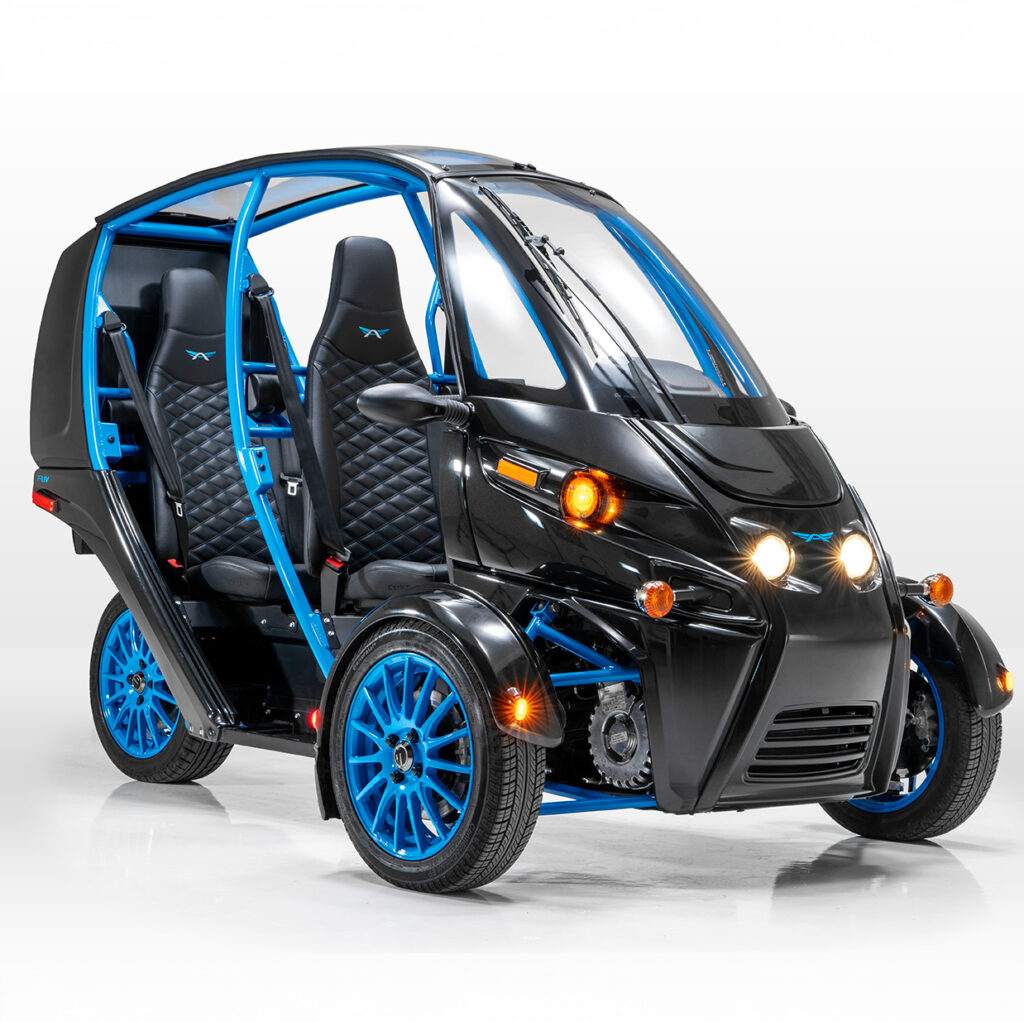
The tandem provides a fun, interesting driving experience that replicates the feel of a fighter-jet cockpit. The vehicle has been optimized for a single-driver experience, and it has the ability to accommodate a second passenger when necessary.
The Pulse implements a keyless entry and ignition system for which individualized codes are assigned to the drivers.
The vehicle includes a standard AV dock that will allow for stereo system upgrades and customizations.
Yes, the Pulse includes AC as a feature upgrade.
Yes. We will offer a range of vehicle colors during production.
There is a medium sized storage space in the rear of the vehicle designed to fit 3-4 full grocery bags.
The vast majority of driving trips involve only one passenger in a vehicle. However, a second seat is often needed for brief periods of time. A two-seat configuration provides convenience while still optimizing the vehicle for efficiency and performance.
The weight of the overall vehicle is reduced by optimizing space more appropriately for two passengers. Also, the aerodynamic efficiency of the vehicle is increased by its thin, tapered shape (a raindrop is the most aerodynamically efficient form).
Technical
Yes, range is a function of battery capacity, vehicle efficiency, and overall reliability. The main drawback of using Lead-Acid batteries is that they are much heavier than other chemistries, and this must be compensated for in terms of range by adding battery capacity.
All of the major electronic and motive systems are properly ventilated and utilize forced convection (fans blowing).
Battery life will be dramatically extended if you keep the batteries as charged as possible at all times. Therefore, it is better to top off the charge on your vehicle whenever possible rather than continuously drive it to zero. Also, it is better for the batteries if you store the vehicle fully charged rather than with the batteries depleted.
Our lead-acid batteries are 97% recyclable.
No, our analysis of regenerative braking has led us to conclude that improving the efficiency of other aspects of the vehicle and/or adding additional battery capacity wins out in a cost-benefit analysis.
The Pulse obtains its best efficiency at lower speeds. Additionally, the motor has no idling state while the vehicle is at rest, which makes stop-and-go driving significantly more efficient than in an ICE vehicle.
Round trips of over 50 miles can be accomplished by plugging the vehicle in at work, in public parking lots, or at other households. The vehicle can be fully charged in 6-8 hours. Incremental charging for shorter periods of time will also help extend the range and battery life of the vehicle.
The vehicle may only be charged on a standard 110-volt outlet at this time. The vehicle comes with a power cord and charger.
At this point, the cost of lithium ion batteries is prohibitive for electric vehicles in our price range. As the cost of lithium ion batteries continues to decrease, we will be looking at incorporating them into our vehicles.
We are using AGM Lead Acid Batteries. These are military spec batteries that have been tried and tested in the toughest of conditions. Additionally, the batteries are solid state, meaning that there is no battery acid present that could potentially leak in the event of a collision or otherwise.
First, the Oregon gets over 60% of it's electricity from hydroelectric power and only 8% from coal. Nationally, nearly 50% of our power comes from coal with only 6% coming from hydroelectric and 20% from nuclear. So, Oregon's energy sources are in general much cleaner than the national average. Second, even in the parts of the country that primarily use coal as an electricity source, electric vehicles reduce overall carbon emissions significantly. This is primarily due to the inefficiency of internal combustion engines as well as the relative overall efficiency of electric vehicles (electric motors, light weight, aerodynamic).
The motor is 62 horsepower with 80 foot-pounds of torque. Our electric motor is about 85% efficient on average compared to 25-30% for a typical IC engine.
Despite recent advancements in automotive flywheel technology, they are still very expensive to implement and present more hazards than typical batteries do. Some F1 racecars utilize flywheels to provide quick bursts of acceleration, but extreme current dumps are not required in our application.
Unfortunately, it is impossible to recapture energy that is not being expended in the first place. In general, energy recapture is possible anywhere that heat is being generated in the vehicle. Internal wind turbines would actually add to the vehicle's overall aerodynamic drag, causing it to lose more energy than would be gained.
Including solar panels on the roof is not currently a cost-effective method of capturing energy. Solar panels have a more attractive payback time when they are placed on a rooftop, where they have a significant surface area and can be utilized whenever the sun is shining. This energy can be used to charge the vehicle or to deliver clean, renewable energy back to the electricity grid.
No, there is no oil to change.
Three wheel vehicles handle extremely well, especially in the reverse trike configuration (two wheels in front, one wheel in back). In this configuration, there is no loss of stability during emergency braking, when the largest g-forces usually act on the car.